

作品賞
平靜深處
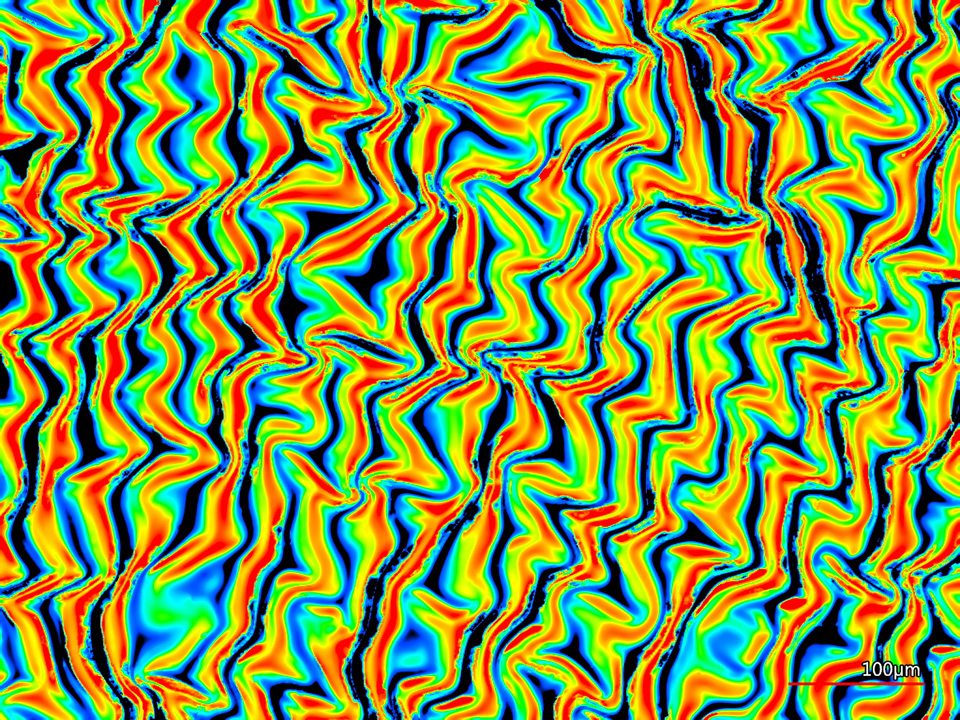
自然中皺褶型態是相當普遍且容易觀察,以不同尺度層級出現在生活中,大至地球表面的山脈褶皺,小至皮膚組織的皺褶細紋。然而這些表面皺褶紋路的形成主要是因為上下軟硬質層間的應力不平衡所產生。山脈褶皺和皺褶細紋也有著相同現象,下層較軟的地函和真皮層,因為流動性和物質的流失產生應力,對上層較硬的地殼和表皮作用而產生皺折。 當表面皺褶紋路達微米或奈米尺度時,可以增加物體的表面積,進而增加物體的接觸面積提升磨擦力達到吸附效果,如抓取物品的指紋與行走在牆壁的壁虎。因此具有皺褶結構的表面在吸附黏著上具有極高的應用發展潛力。 為了仿生製作出小尺度的皺褶結構,使用兩種不同軟硬程度的高分子材料(PDMS/PLLA),進而技術性的釋放產生應力使表面皺褶圖案化,透過共軛焦雷射掃描拍攝表面結構,得到自發且高有序的微米尺度皺褶。而照片中的漸層顏色是儀器系統本身對皺褶高低差的顯示方式。
Wrinkle patterns in nature are quite common and easy to observe. They appear in life at different scales, ranging from mountain ranges on the earth's surface to small folds of skin tissue. The formation of these wrinkles is mainly due to the stress imbalance caused by the hardness difference of upper and lower layers. Mountain folds and skin fine lines share the same phenomenon. The soft lower mantle and dermis layer, because of the fluidity and the loss of material, generate stress, and cause the upper layer of the harder crust and epidermis to fold. When the surface wrinkles reach the micron or nanometre scale, the surface area of the object will be increased, and the contact area of the object can be increased which in turn increases the surface friction to achieve the adsorption effect, such as obtaining the fingerprints of objects or geckos walking on the wall. Therefore, surfaces with wrinkled structure have a high potential in application development in terms of adsorption and adhesion. In order to bionically produce a small-scale wrinkle structure, two kinds of polymer materials (PDMS/PLLA) with different hardness degrees are used, and then the stress is technically released to form the surface wrinkle pattern, and the surface structure is scanned and photographed by confocal laser, resulting in self-induced and highly-ordered micron-scale folds. The gradient colour in the photo is the way the equipment system itself displays the height difference of the folds.
2019年9月25日拍攝于國立中興大學材料科學與工程學系。使用共軛焦顯微鏡拍攝高分子聚L–乳酸(PLLA)自發高有序皺褶表面紋路。拍攝原理是透過共軛焦的雷射掃描方式,對具有高低差的物體表面由低而高掃描迭圖而成,照片無任何後制與修改,僅選用不同高度顯示之調色盤。
Photographed on September 25, 2019, in the Department of Materials Science and Engineering at National Chung Hsing University. Self-induced and highly-ordered wrinkles on poly-L-lactic acid (PLLA) were photographed using a Laser Scanning Confocal Microscopy. The shooting is done by the confocal laser scanning, and the surface of the object with a difference in height is scanned and overlaid from low to high levels. The photo was not processed or modified. Only colour palettes were used to indicate different heights.